Inclusive Leadership Lab
- Principal investigator
- Seth Looper
- My role
- Founder, lead designer, and facilitator
- Co-sponsor
- International Student Experience Office (ISEO), Dartmouth
- Institution
- Dartmouth College
- Date
- May 22, 2026 · McNutt Hall 001
- Companion field note
- Anchor, then hold space
- Format
- Two-hour workshop · 41 slides · 3-page worksheet
- Audience
- International undergraduate peer mentors preparing for fall mentor-mentee match introductions
- Status
- Pilot
- Addresses
- RQ 3 · RQ 5
- Source frameworks
- Burnett & Evans Life Design; Knowdell Career Values; McAdams's narrative identity
- Methods used
- Narrative compression, Card-sort triangulation, Peer conversation
What this report argues, how far the evidence currently goes, and what would settle it. The lab states this up front so a reader can weigh the work honestly.
The default frame for inclusive leadership is competency: cultural intelligence, openness, bias mitigation, collaboration. Things a leader has. The framing is useful for hiring and assessment, but it leaves a specific question unanswered: what does the leader actually do, in the room, when the person across from them is anxious?
For international undergraduate peer mentors at Dartmouth, the answer to that question matters in a particular way. Mentors are about to begin match-introductions with first-year international students. The mentee is often the harder party in the room: adjusting to a new culture, a new language, sometimes a visa story they can't talk about. The mentor's competency list won't help if the mentee retreats into silence.
A pre-workshop survey of the mentor cohort (n=13 of approximately 20) surfaced two findings that anchored the workshop's design. Seventy-seven percent of mentors said they default to asking questions when a mentee shares anxiety. Thirty-eight percent named the mentee not engaging as their biggest fear about being a mentor this fall. Mentors who think they ask questions but fear disengagement are mentors with a script, not a stance. The script falters when the mentee resists.
A two-hour workshop in three acts: an invitation, an anchor build, an offering. The central reframe sits at the boundary between acts one and two: inclusive leadership is staying anchored in your own narrative so that you can hold space for someone else to find theirs. Two clauses, both required. Anchor without holding space is performance. Hold space without anchor is dissolution. Both at once is co-authorship.
An originally-planned fourth module, a question-only roleplay practice block, was cut for time. The cut is named explicitly in the closing slides; it isn't papered over. Honest acknowledgment of what didn't happen is itself a design move, and the closing slide proposes two specific summer or September practice options to address the gap.
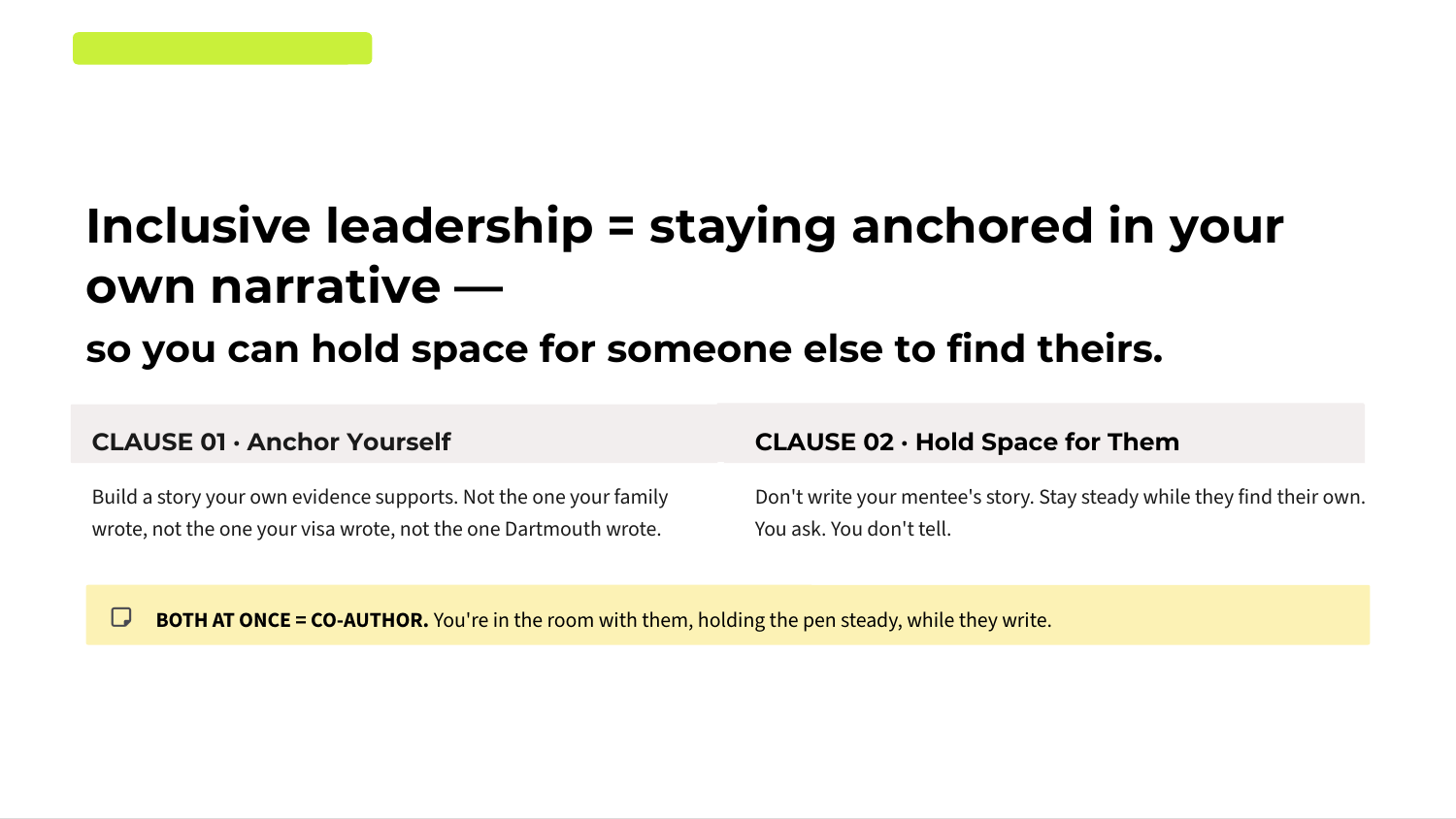
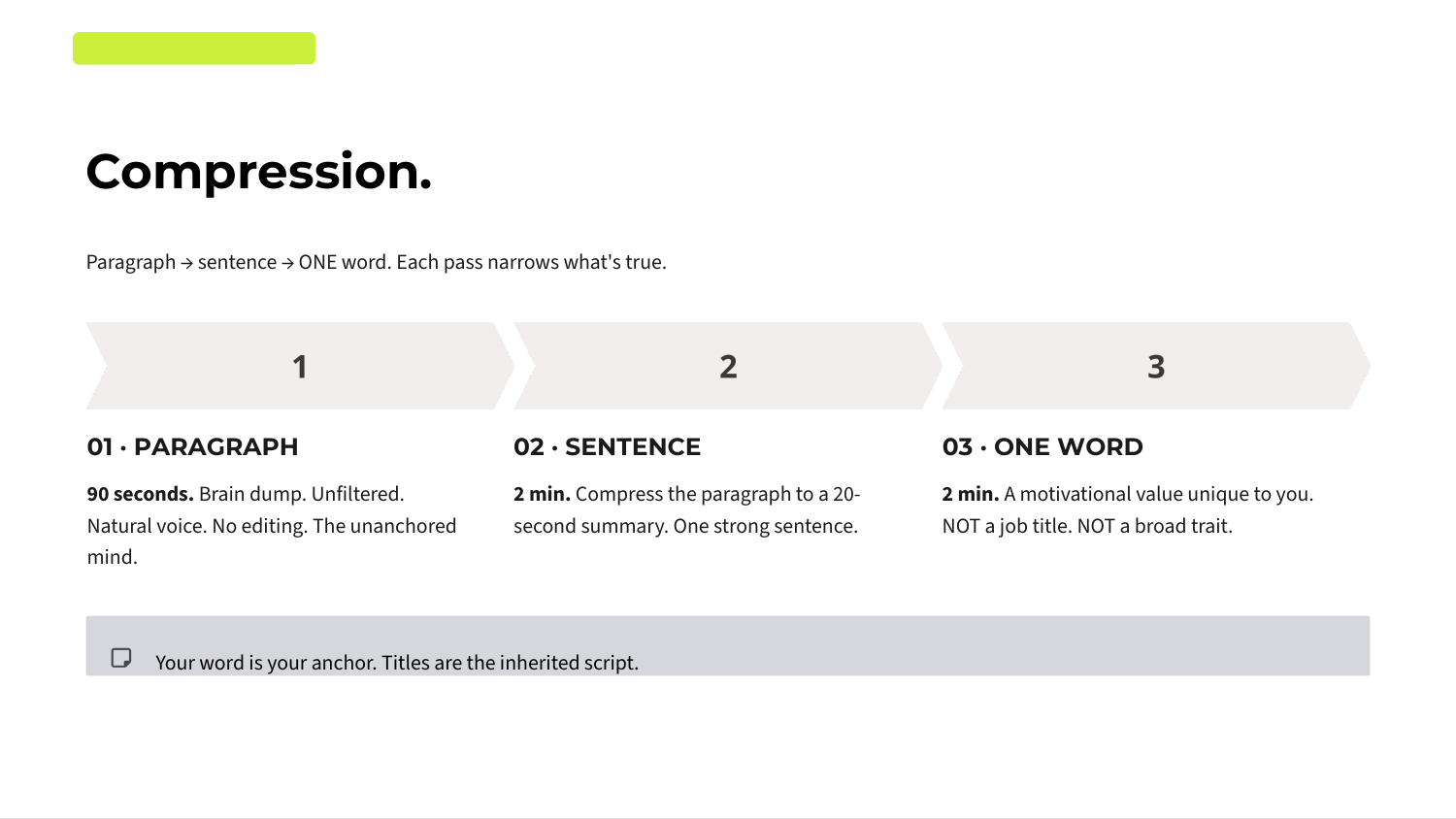
The workshop is a recombination of two of the lab's existing pieces, redirected at a different developmental task. The compression operation (paragraph to sentence to single word) comes from Narrative by Design, where it supports career narrative discovery. The values-test discipline (Knowdell card sort, top five forced) comes from the Career Design Lab program, where it grounds identity work in evidence. The Inclusive Leadership Lab uses both, but points them at a mentor population preparing to hold space rather than at students preparing to find direction.
The theoretical frame for that redirection rests on four pieces. Burnett & Evans's Designing Your Life (2016) is the source of the Odyssey Plan in M3; the workshop adapts the format for mentor purpose rather than personal direction. Dan McAdams's narrative identity theory (McAdams, 1993) grounds the compression sequence: identity as the story a person edits and re-edits, with prioritization as the editing operation. Lee Shulman's signature pedagogies (2005) frames the workshop's reliance on group facilitation, table share, and structured peer dialogue as a domain-appropriate teaching form. The inclusive leadership literature (Bourke & Espedido, 2019; Hewlett et al., 2013) is positioned as the frame the workshop reframes: not as a competency cluster but as a relational stance.
The lab's Anchor, then hold space field note develops the pedagogical claim more directly. The lab's Compression as a method note traces the compression operation across multiple projects.
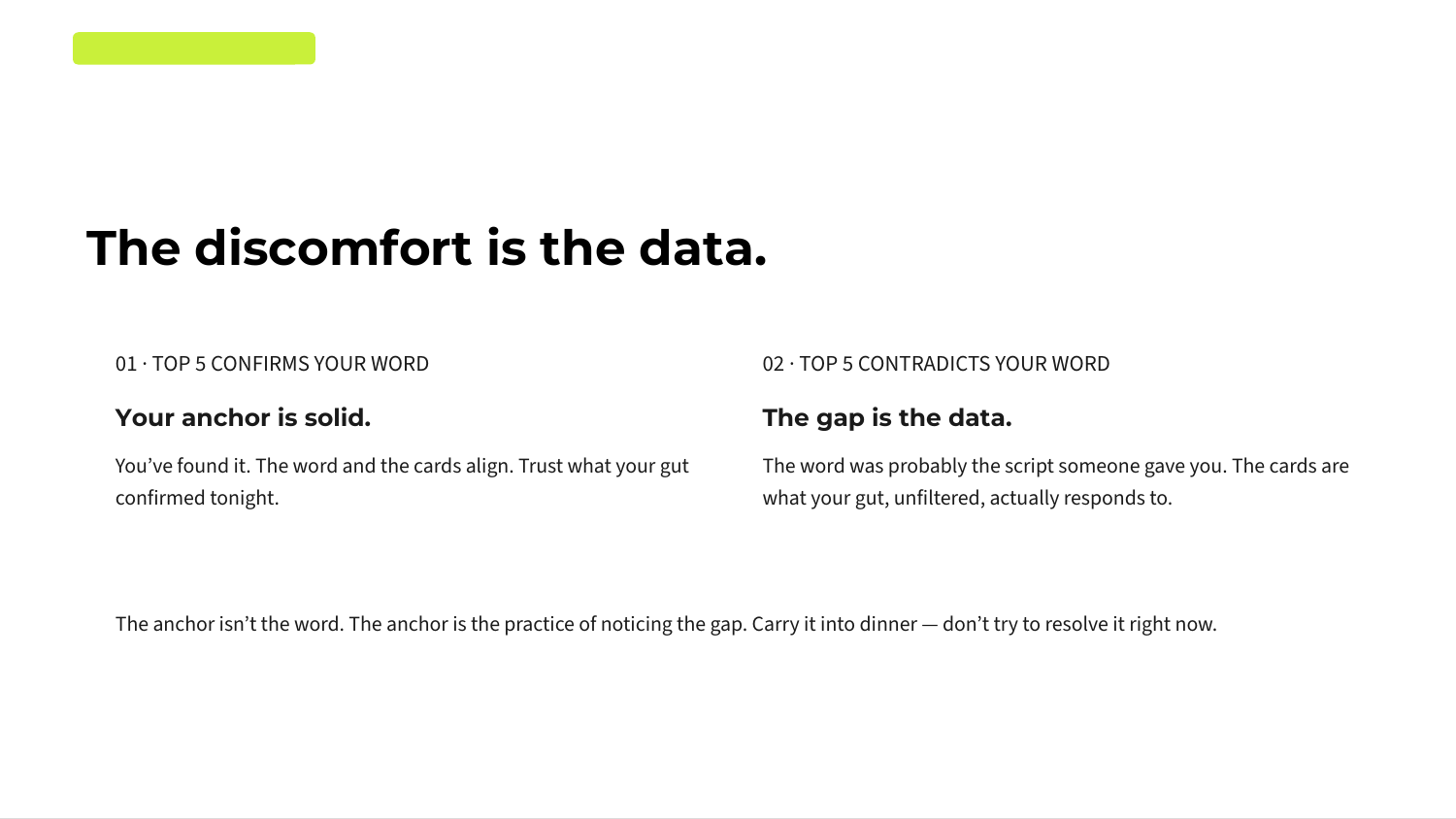
A short anonymous survey was sent to the mentor cohort approximately 48 hours before delivery. Thirteen of approximately twenty mentors responded, a 65% rate. The five questions covered clarity, articulation confidence, default response to mentee anxiety, hoped-for outcomes, and biggest fears about the fall.
The workshop was delivered once, May 22, 2026, McNutt Hall 001. Approximately twenty mentors participated. A post-workshop survey instrument is in preparation and will be sent within the standard one-to-three-week window. A second follow-up touchpoint is planned for mid-to-late September, two to three weeks after ISEO match-introductions begin: have you had occasion to use your anchor with a mentee yet? Tell us what happened, or what's gotten in the way.
The workshop's full pedagogical contribution will be documentable once post-delivery and September follow-up data are in. The current artifact is the design rationale: the deck, the worksheet, the pre-survey, the iteration history (V1 through delivery, with intern review and a specific Q3 reversion documented). The replicability claim is on the design vocabulary, not on the outcomes: practitioners building leadership workshops for non-native-English-speaking undergraduate audiences can borrow the ESL-conscious design moves, the anchor-and-hold-space reframe, and the Compression + Card Sort sequence.
A working paper documenting the design rationale and pre-survey findings is in preparation. An evaluation paper that pairs design with post-delivery data is on a longer timeline.
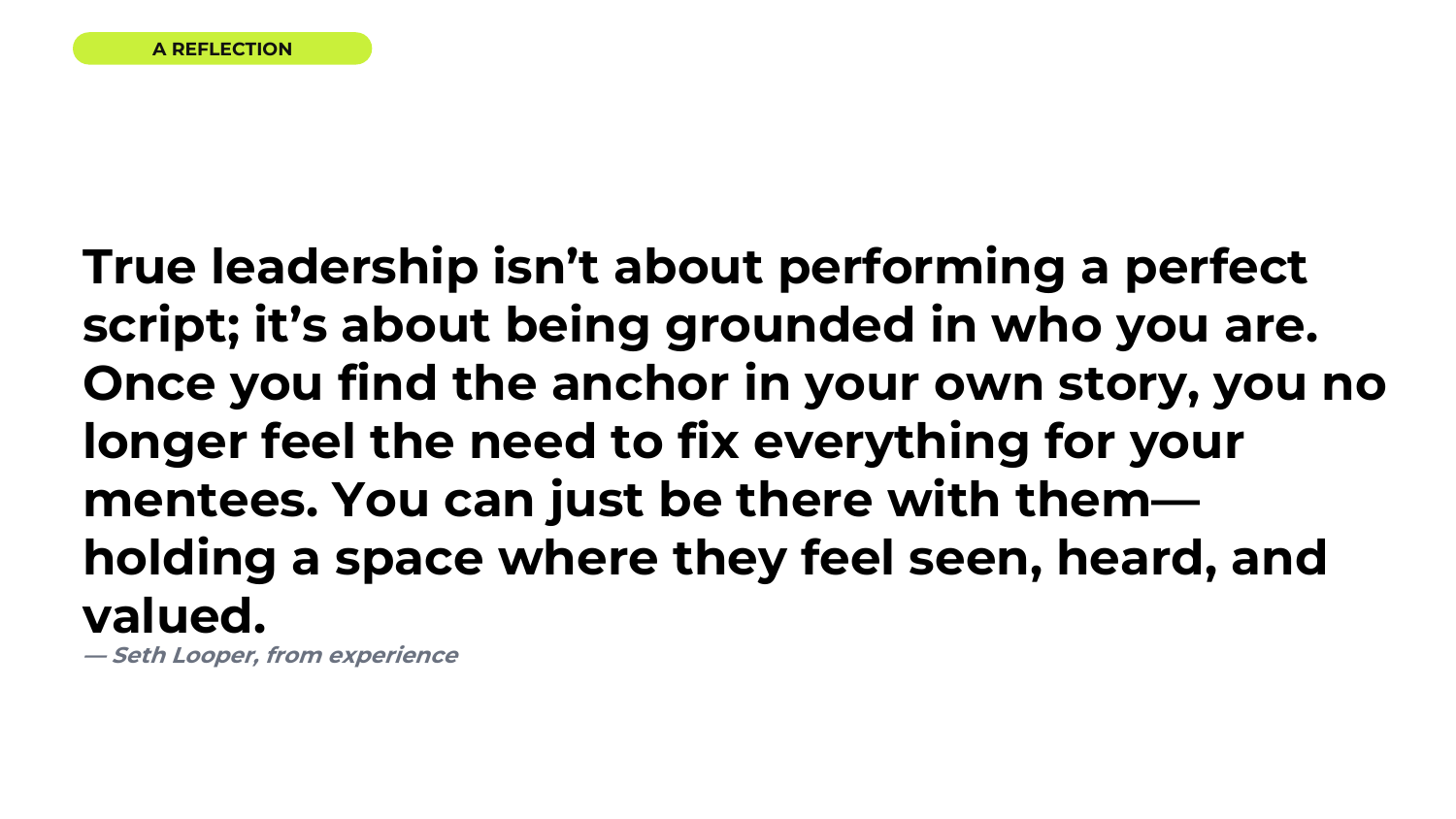
Looper, S. (2026). Anchor and Hold Space: Inclusive Leadership as Narrative Co-Authorship in a Two-Hour Workshop for International Undergraduate Peer Mentors. Lo/Be Lab Working Reports, 2026-04. [pdf]
A design-rationale paper documenting the workshop's architecture, the pre-workshop survey instrument and findings (n=13), the iteration history, and the five contributions the workshop offers as a replicable design vocabulary. Post-workshop evaluation is in preparation; outcomes will be reported in a forthcoming paper. See the companion field note: Anchor, then hold space.
Material on this site may be cited and reused freely, provided that it is duly credited as a project of Lo/Be Lab and that a copy of any publication referencing the work is sent to seth.looper@gmail.com.
For citation requests, collaborations, or pushback on a published claim, seth.looper@gmail.com. Site licensed under CC BY-NC 4.0.