Narrative by Design
- Principal investigator
- Seth Looper
- My role
- Founder, lead designer, and workshop facilitator
- Past collaborators
- Lin Liu, Xiaoxi Tan (2025)
- Institution
- Dartmouth College
- Period
- 2024–present
- Cohort
- Multi-term pilot at Dartmouth; expanding beyond Dartmouth in 2026
- Companion app
- ccd-nbd.vercel.app
- Format
- 90-minute facilitated workshop, 5 students or fewer per group
- Status
- Pilot
- Addresses
- RQ 2 · RQ 4
- Instruments adapted
- Knowdell Career Values; CliftonStrengths; Motivated Skills
- Methods used
- Narrative compression, Card-sort triangulation, AI-as-mirror
What this report argues, how far the evidence currently goes, and what would settle it. The lab states this up front so a reader can weigh the work honestly.
Ask a student "tell me about yourself" and you get one of two things: a chronological list of everything they've done, or a rehearsed script that sounds like everyone else. Neither works. The list is too long and has no center. The script has no life in it. Both miss the point, which is to say something true about who you are and what drives you, in a way that actually lands.
The gap isn't missing experience. Students have plenty. The problem is that nobody teaches them how to look at their experience, find the thread running through it, and compress it into something clear. Career services gives them resume templates and interview scripts. What they need is a method for figuring out what their story actually is, before they try to tell it.
To be clear about what this isn't: Narrative by Design is not a resume-polishing session. It's not an interview script workshop. It's not a program that forces students to choose a major or career path in one sitting. It's a repeatable framework, something students can return to as their experiences and goals change.
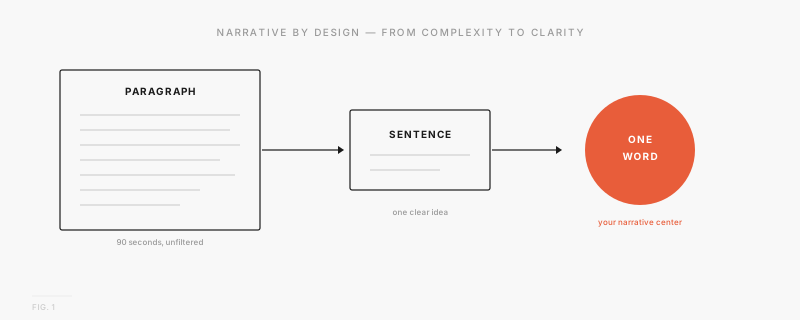
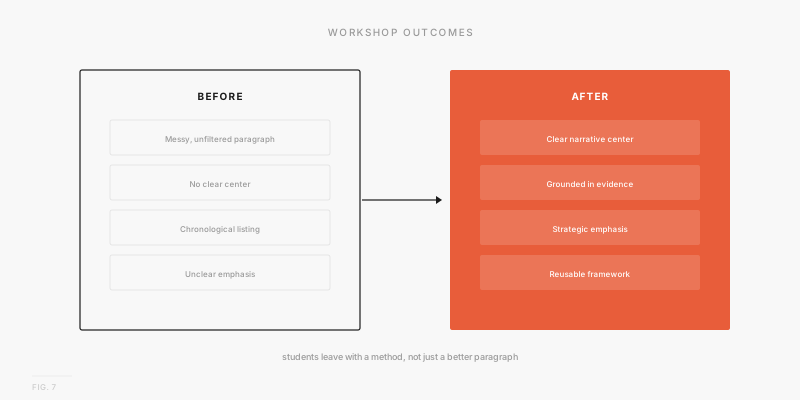
Narrative by Design is a 90-minute facilitated workshop built around one core idea: narrative compression. Students start with a messy, unfiltered paragraph about who they are. Then they cut it to a sentence. Then a single word. Each compression forces a choice. What you keep and what you drop tells you what actually matters.
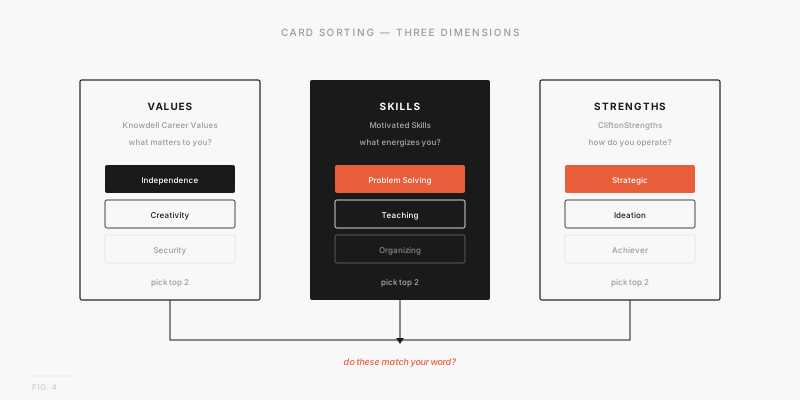
The workshop pairs this compression exercise with structured reflection tools, card sorts for values, strengths, and skills, that ground the narrative in evidence rather than aspiration. A companion web app (ccd-nbd.vercel.app) guides students through each phase and provides a space to do the work.
Narrative by Design is the most theoretically loaded of the lab's tools. The workshop has three layers, each with its own anchor.
The compression sequence (paragraph → sentence → single word) is grounded in Dan McAdams's narrative identity framework (McAdams, 1993): identity is the story you keep editing, and forcing prioritization is the editing move. The single word isn't a brand or a permanent label; it's the smallest object that still has structure. The lab's Compression as a method note traces why this exercise keeps appearing across our projects, and the The 90-minute constraint note explains why the format's time-pressure does pedagogical work.
The card-sort instruments (values, strengths, skills) are adapted from Knowdell Career Values, CliftonStrengths, and the Motivated Skills tradition. They're used not as assessments but as evidence the student can hold up against their own narrative. Card sorts are themselves a form of compression (top 10 → top 5 → top 3).
The AI-as-mirror layer is designed around Jack Mezirow's transformative learning theory (Mezirow, 1997), specifically Mezirow's "disorienting dilemma," the productive gap between how you see yourself and what the evidence shows. The AI's job is to surface those gaps, not to recommend a resolution. The lab's AI as mirror, not advisor note documents how the design choice differs from the recommendation-engine default.
The overarching frame is Burnett & Evans's Designing Your Life (2016): identity work as a repeatable design process, not a one-time decision. Full bibliography in the working paper.

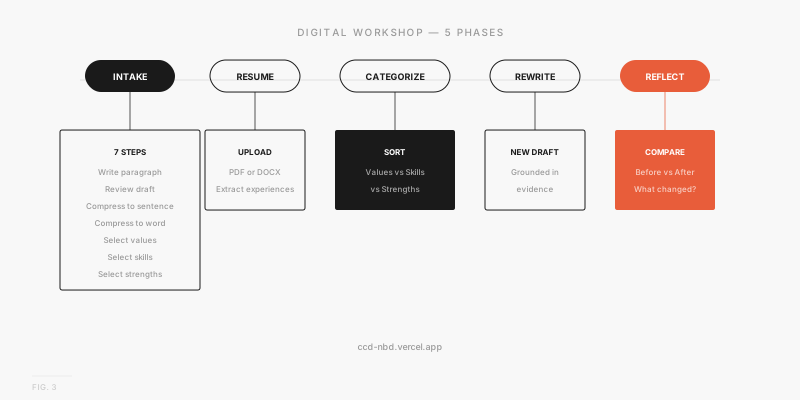
The workshop moves through five phases. Each one builds on the last.
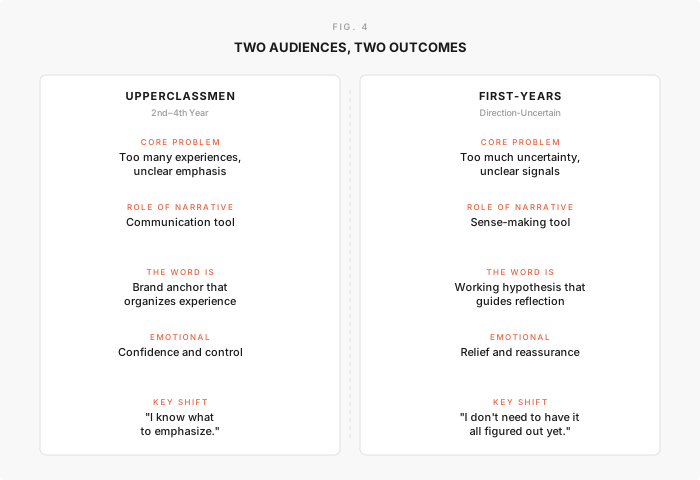
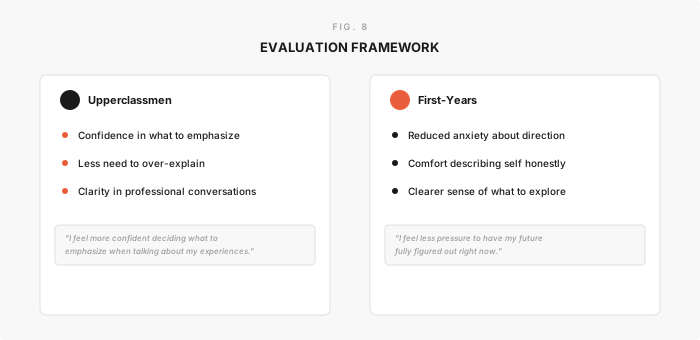
The format is the same for everyone. The design predicts different developmental targets depending on where the participant is.
Three premises that organize the workshop's design and that the empirical-study stage is set up to test:

We evaluate the workshop not by general satisfaction but by developmentally aligned outcomes, different questions for each group.
The workshop is designed to support two outcomes the lab will study under a future consent and review process: a clearer articulation of what the participant cares about, and a clearer sense of how to communicate it to others. These are the outcomes the format optimizes for; whether the workshop actually produces them at the predicted strength is one of the open empirical questions documented in the working paper's §5.4.
Narrative by Design is currently in pilot at Dartmouth College. Spring 2026 is focused on testing with participants beyond the initial pilot group to refine the format. By fall 2026, the plan is to launch it as a regular offering, available as one-on-one appointments or small group workshops. Longer term, we're training facilitators to run it for student clubs and outside organizations, so the program can move past Seth-as-only-facilitator.
The web companion is live at ccd-nbd.vercel.app.
Looper, S. (2026). Compression with a Witness: Narrative by Design, AI-as-Mirror, and the 90-Minute Workshop as Research Instrument. Lo/Be Lab Working Reports, 2026-01. [pdf]
See the full abstract on the publications page.
Material on this site may be cited and reused freely, provided that it is duly credited as a project of Lo/Be Lab and that a copy of any publication referencing the work is sent to seth.looper@gmail.com.
For citation requests, collaborations, or pushback on a published claim, seth.looper@gmail.com. Site licensed under CC BY-NC 4.0.