Synapse
- Principal investigator
- Seth Looper
- My role
- Founder, lead designer, and sole developer
- Past collaborators
- Lin Liu, Xiaoxi Tan (2025)
- Institution
- Dartmouth College
- Data sources
- U.S. Bureau of Labor Statistics (BLS); O*NET
- Corpus
- 460 occupations, 13 questions
- Live at
- sethlooper.com/synapse
- Period
- 2024–present
- Status
- Active
- Addresses
- RQ 2
- Methods used
- Spatial mapping, Binary elicitation, tag-overlap recommender with diversity rules
What this report argues, how far the evidence currently goes, and what would settle it. The lab states this up front so a reader can weigh the work honestly.
Career assessments give you a ranked list. You answer questions, the system spits out occupations sorted by fit score, and you look at the top five. Two problems with that. First, it treats every career as separate. A student interested in urban planning might also connect with public health or environmental policy, but a list doesn't show you those connections. Second, nobody looks past the first few results. The format itself kills exploration.
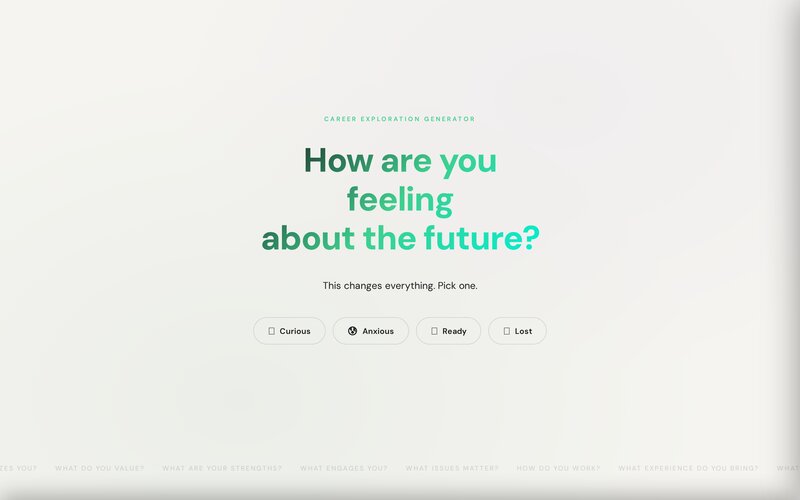
Synapse asks 13 either/or questions about how you think, what energizes you, and what kind of impact you want. Instead of returning a ranked list, it maps your answers against 460 real occupations (from BLS and O*NET data) on a visual map. Careers that share characteristics sit near each other. You can wander through clusters of related jobs and find connections you never would have found by searching or scrolling.
Synapse is built on a small number of established frames. Each shaped a specific design decision.
The 13 questions map to Holland's RIASEC dimensions (Holland, 1959; Holland, 1997), the six interest types that organize O*NET's Interest Profiler and the bulk of vocational-assessment infrastructure in U.S. counselor education. The forced-choice format (either/or, not Likert) follows the same tradition's emphasis on producing clear signal at low cost rather than nuanced self-description.
The 460 careers are drawn from the BLS Standard Occupational Classification (SOC) and O*NET 26.0, federal data, not editorial selection. This matters: the corpus isn't shaped by what the lab finds interesting; it's the same taxonomy a school counselor or labor economist would work from.
Two non-default moves come from outside the assessment tradition. First, the results page replaces the ranked list with a spatial map. The wayfinding framing comes from Burnett & Evans's Designing Your Life (2016): careers as a landscape to walk through rather than a leaderboard to optimize. (The lab's Maps over lists field note has more on why this pattern keeps showing up across our projects.) Second, the prompts are mood- and values-laden rather than skills- or experience-based. That choice draws on Mark Savickas's Career Construction Theory (Savickas, 2005), which treats career-related decisions as identity construction not slot-filling, and on the Knowdell Career Values card-sort tradition that recurs across Lo/Be Lab's other tools (see Narrative by Design).
The full set of cited works is in the working paper.
Synapse is a working product looking for a defensible evidence base. Seven research lines are being pursued. Each is framed as: what we want to learn, and what would change on the site if we learn it.
Two further lines (longitudinal reliability via localStorage snapshots; backfill of prestige-disadvantaged careers like welder, paralegal, and dental hygienist) are in scope but lower priority for the current 90-day cycle.
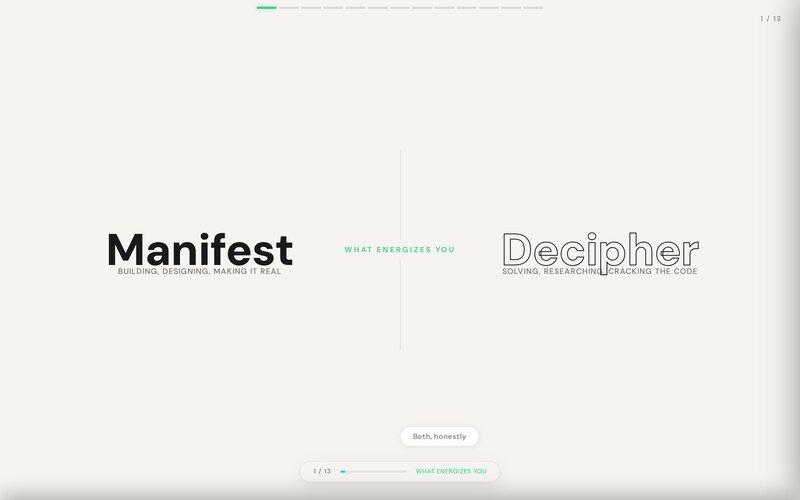
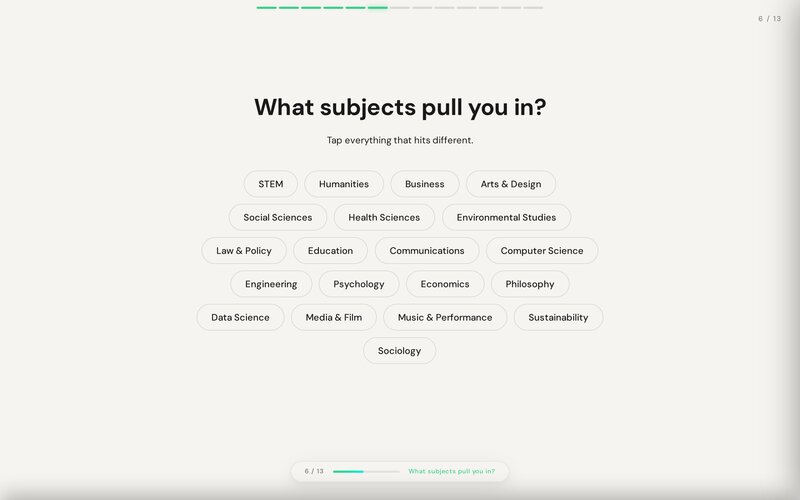
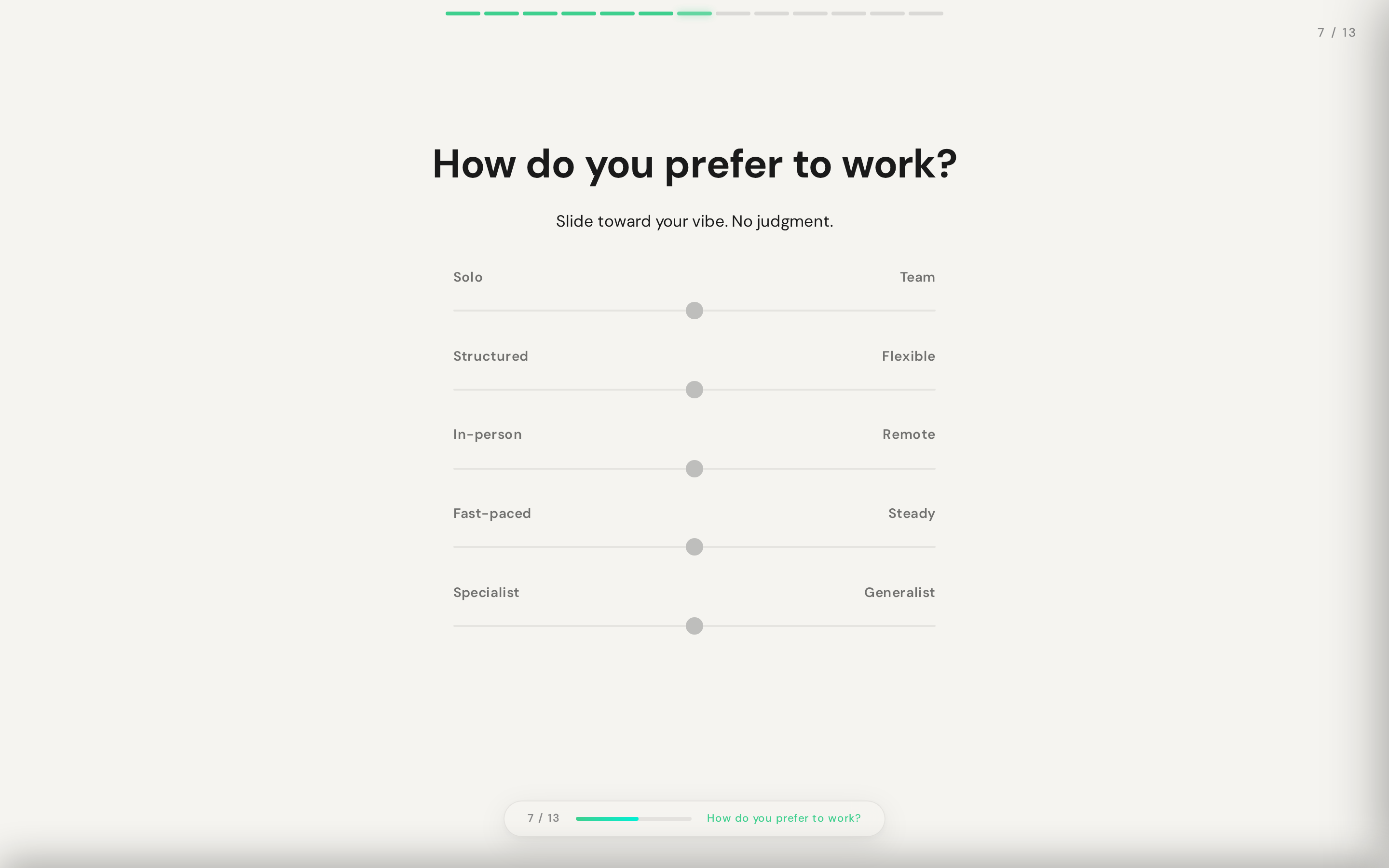

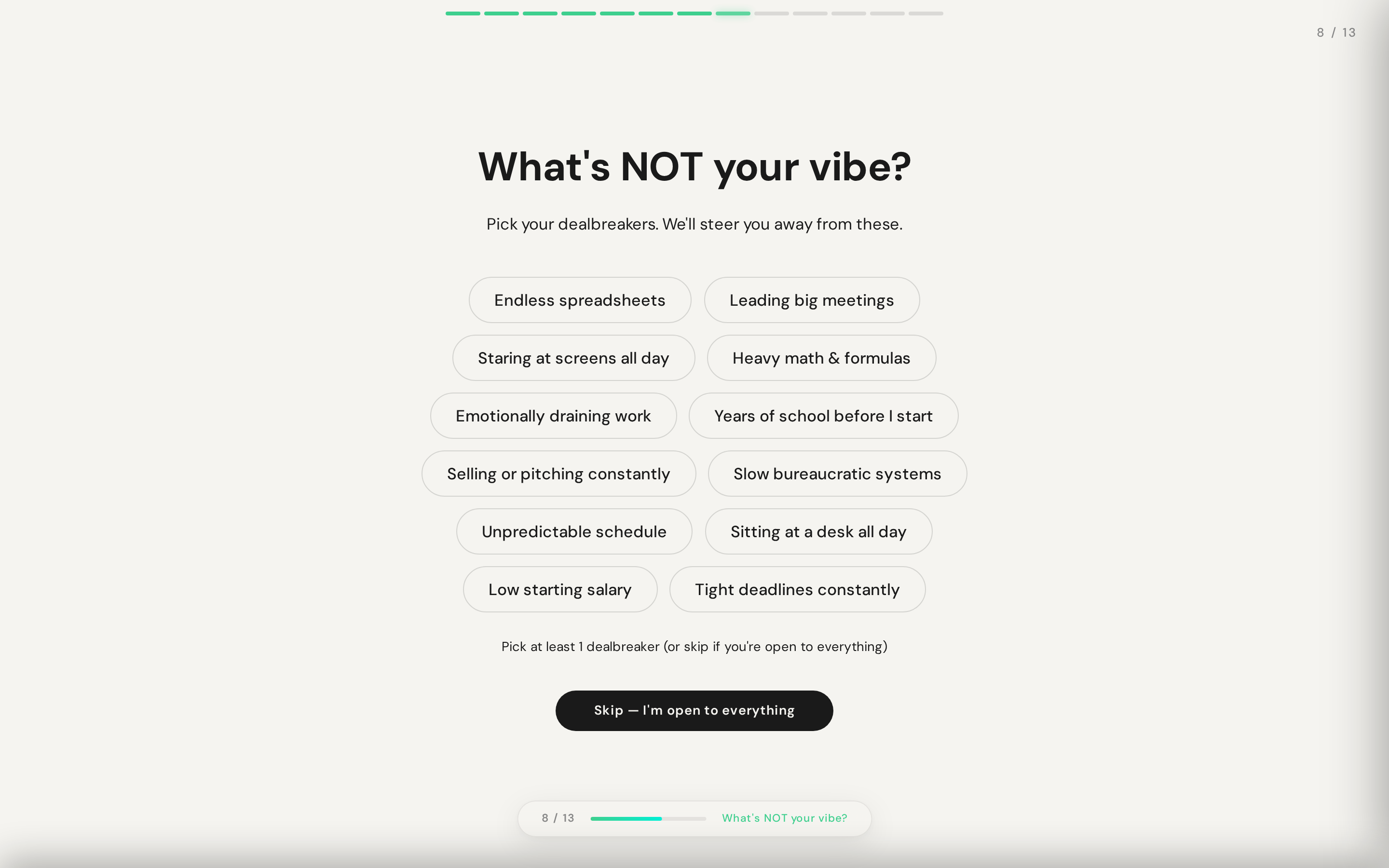
The first version was a traditional quiz with a ranked list of results. The redesign moved the output to a spatial map because the wayfinding metaphor predicts a different mode of engagement: exploration rather than selection. The question count was reduced from 20 to 13 across design iterations, keeping the set that produced the most distinct profiles in design-team review. All career data comes from BLS Occupational Employment and Wage Statistics and O*NET.
Three design-rationale claims the spatial-map move rests on. Each is a hypothesis the working paper documents in §5.3 and that the empirical-study stage is set up to test under a future consent infrastructure.
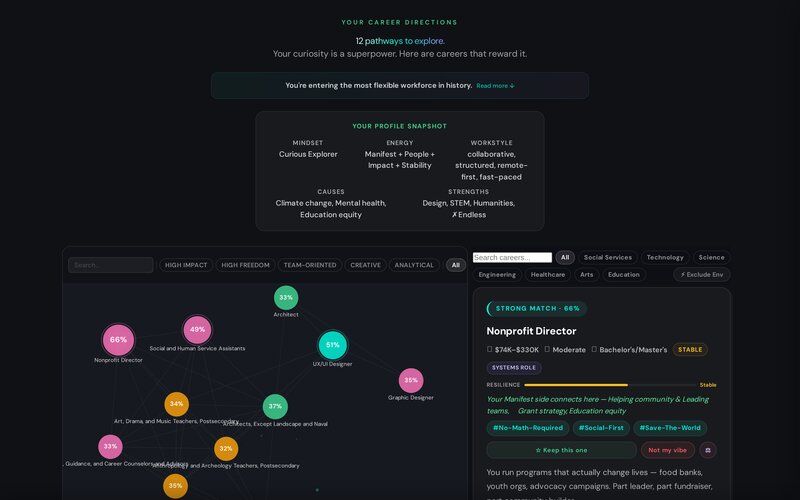

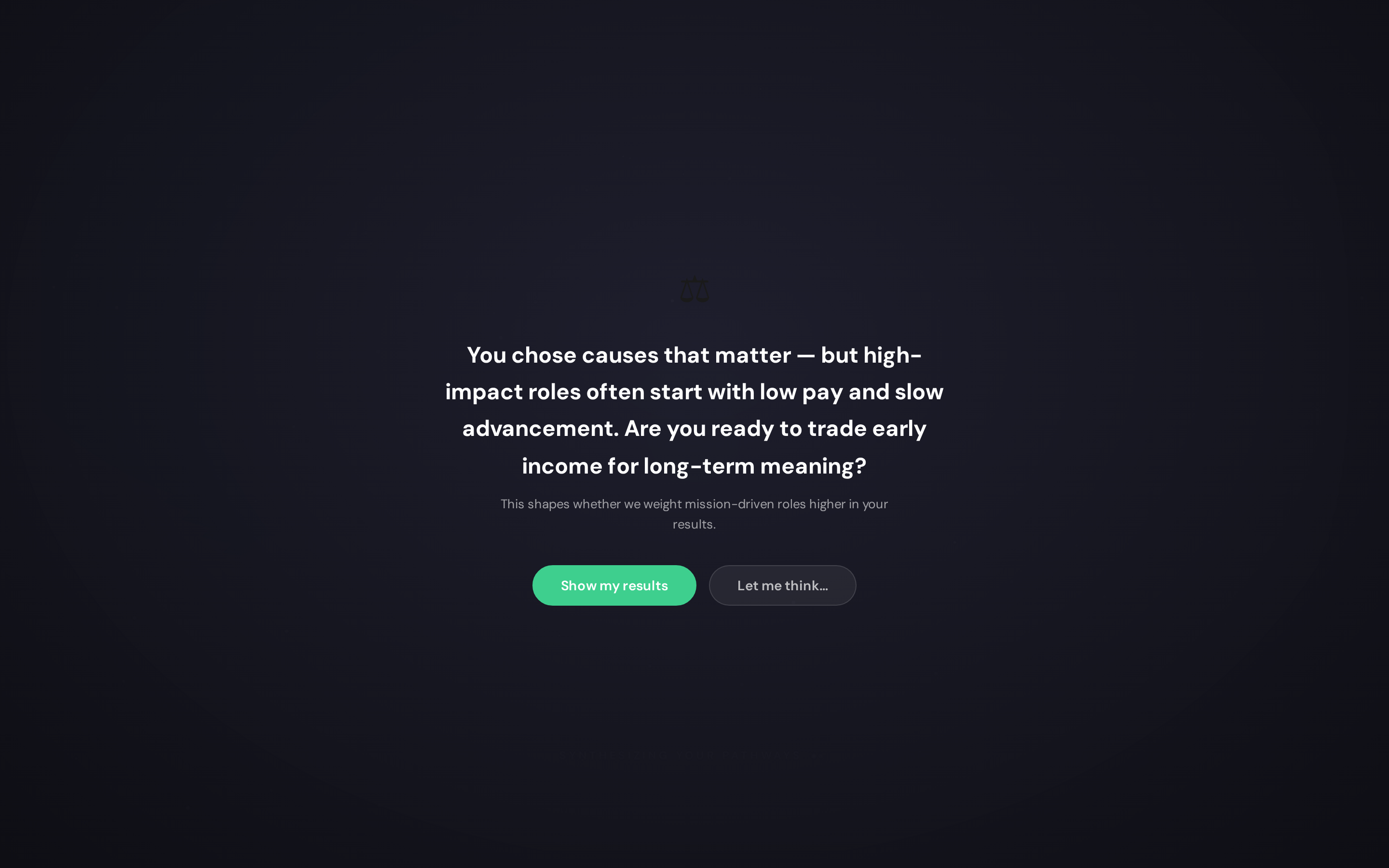
Synapse is live at sethlooper.com/synapse and is part of the Career Design Lab program at Dartmouth. Whether spatial exploration improves the quality of downstream decisions compared to list-based tools is one of the open research lines the working paper documents; it would require partnership with a counselor-education program with IRB infrastructure to test directly.
Looper, S. (2025). From Ranked Match to Spatial Map: A Design-Based Inquiry into Career Exploration Interface Affordances. Lo/Be Lab Working Reports, 2025-01. [pdf]
See the full abstract on the publications page.
Material on this site may be cited and reused freely, provided that it is duly credited as a project of Lo/Be Lab and that a copy of any publication referencing the work is sent to seth.looper@gmail.com.
For citation requests, collaborations, or pushback on a published claim, seth.looper@gmail.com. Site licensed under CC BY-NC 4.0.